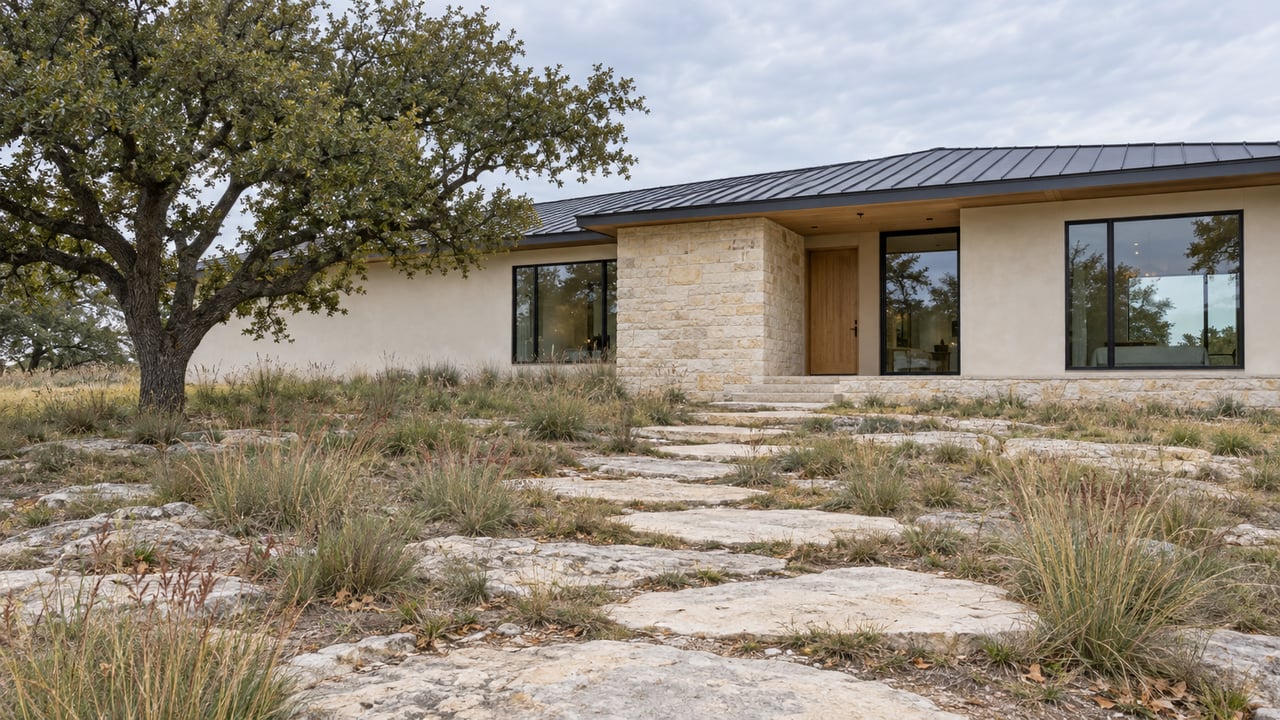
A buyer walks a five-acre tract west of town. The listing says well and septic in place, ag-exempt, low taxes. She pictures a second well for the barn she wants to build, maybe a guest casita down the road. Then she calls the Hays Trinity Groundwater Conservation District to ask about a permit for that second well and learns the district is not accepting new non-exempt permit applications right now. Not slow-walking them. Not reviewing them. Not accepting them.
That single phone call is the reason this piece exists. Three things on a Dripping Springs acreage listing look like fixed features of the property: the well, the septic system, and the tax bill. All three are actually descriptions of how the current owner uses the land, and all three can change the moment title transfers to someone new.
The Hays Trinity Groundwater Conservation District covers western Hays County, including most of the acreage around Dripping Springs. As of this writing, the district's own site states it plainly: the district is currently in Emergency Drought Stage, wells are failing at an unprecedented rate, and no new permits for production or non-exempt well construction will be accepted until conditions improve.
That freeze comes from a specific rule change. Under Rule 13.3.3, the district's board suspended acceptance of new operating permit applications, permit amendment requests for more water, and new well construction notifications for non-exempt wells during Stage 3 (Critical) or Stage 4 (Emergency) drought conditions. Applications only resume once the district returns to Stage 1 or Stage 2.
The district's own drought data does not suggest that's imminent. Its most recent drought management figures estimate the region needs 26 inches of precipitation to end the drought within six months, with less than a 6.5 percent probability of that happening in that window.
Here is where the nuance matters for a buyer instead of a headline. The freeze targets non-exempt wells and any permit amendment asking for more water. A single modest domestic well serving one household may still qualify as exempt based on its production capacity, and exempt wells are not what the freeze is built to stop. But any plan that needs more than that, a second well, an irrigation system, a guest house with its own tap, a business use, runs straight into the current moratorium. If your offer depends on drilling anything beyond the existing exempt domestic well, that plan needs a phone call to the district before you waive the option period, not after.
Most acreage around Dripping Springs sits on Edwards Plateau limestone with as little as six to eighteen inches of topsoil before hitting bedrock. Conventional septic systems need several feet of permeable soil to filter wastewater before it reaches groundwater. That thin soil layer is why the county approves aerobic treatment units, drip irrigation, and spray field systems for the overwhelming majority of new permits in western Hays County, not as an upgrade option but as the only design that passes the site evaluation.
The gap between what buyers budget and what they pay is the story here. A common scenario: a family buys five acres outside Dripping Springs or Wimberley, plans a three-bedroom home, and budgets somewhere around $8,000 for septic based on national averages. The site evaluation comes back showing eight inches of topsoil over limestone. The perc test fails. The only approved design is an aerobic treatment unit running $12,000 to $16,000 installed with spray dispersal, plus a mandatory service contract for the life of the system.
| National conventional assumption | Hill Country aerobic reality | |
|---|---|---|
| Install cost | $4,500 to $10,000 | $12,000 to $18,000 |
| Ongoing service | Minimal, occasional pump-out | $300 to $500 per year, contractually required |
| 25-year lifecycle cost | $8,000 to $12,000 | $20,000 to $30,000 |
The permitting layer adds its own friction. Hays County requires an on-site sewage facility permit on every lot regardless of acreage. There is no large-lot exemption. Inside Dripping Springs city limits, the residential OSSF permit fee is $600 plus a $10 state research council fee under the fee schedule the city revised in January 2026. Any aerobic or advanced treatment system also requires a signed two-year initial maintenance contract with a licensed provider before the county or city will approve the application, and state and county rules require inspections on that system every four months going forward, not once at closing and then never again.
If the property falls within the Edwards Aquifer contributing or recharge zone, which covers much of the Dripping Springs area, the design faces an additional layer of state review, and a failed or aging system can carry consequences beyond the property line, since the aquifer it drains toward supplies drinking water well beyond Hays County.
The low property tax figure on an acreage listing usually comes from an agricultural valuation under Article VIII, Section 1-d-1 of the Texas Constitution. The land is taxed on what it produces agriculturally, not on its market value. That is a real and often substantial savings, but it is tied entirely to keeping the qualifying use in place. It is not a discount that belongs to the land forever.
Break that use and the county recaptures the difference. Under current law following HB 3833, that rollback reaches back up to three years, calculated as the gap between what was actually paid and what would have been owed at market value, plus 7 percent interest on any delinquent amount. That bill does not necessarily go to the person who benefited from the low valuation. It goes to whoever owns the land when the qualifying use ends, which is very often the new buyer.
The triggers are not always dramatic. Building a home on a pasture where cattle grazed can end the valuation. So can fencing off a section for a personal yard, or simply letting the fields sit idle after the livestock leave. None of that requires a demolition permit or a public hearing. It just requires the appraisal district to notice, on its regular review cycle, that the use has changed.
There is a second trap for buyers who assume the ag valuation transfers cleanly with the deed. A tract generally must have been used principally for agricultural purposes for five of the preceding seven years to qualify. A seller's existing valuation can carry forward, but the clock behind it does not reset for a new owner. If the previous owner let the qualifying use lapse before selling, the new owner may face a waiting period to establish their own history before claiming the full valuation, even if some counties allow a partial reduction during that transition.
The due diligence step here is straightforward and worth doing before closing rather than after: request the property's account history from the Hays Central Appraisal District and confirm the ag designation is currently active, not just listed as a line item on the seller's most recent tax statement.
The well, the septic system, and the tax bill are not separate risks. They are three expressions of the same fact about this part of the Hill Country. Water, wastewater, and land classification here are all defined by current use, monitored by three different agencies, and reset the moment that use changes hands. A listing sheet describes today. It does not promise tomorrow.
Does every acreage lot in Dripping Springs need a septic permit, even a large one? Yes. Hays County requires an on-site sewage facility permit regardless of lot size or acreage, and the same applies within city limits.
Can I still drill a well right now? A single domestic well serving one household may still qualify as exempt based on production capacity, but the Hays Trinity Groundwater Conservation District is not currently accepting new non-exempt permit applications or amendments requesting more water, and that freeze stays in place until the district returns to Stage 1 or Stage 2 drought conditions.
Who actually pays the rollback tax if the ag exemption breaks? The bill generally goes to whoever owns the property at the time the qualifying use ends, which is frequently the buyer rather than the seller who enjoyed the lower tax bill.
None of this makes Dripping Springs acreage a bad buy. It makes the listing sheet a starting point rather than a settled fact. If you are evaluating a tract out here and want someone to walk through what the well status, the septic design, and the appraisal history actually mean for your specific parcel before you write an offer, Courtney Unangst offers a Strategy Session built around exactly this kind of due diligence.
We pride ourselves in providing personalized solutions that bring our clients closer to their dream properties and enhance their long-term wealth. Contact us today to find out how we can be of assistance to you!